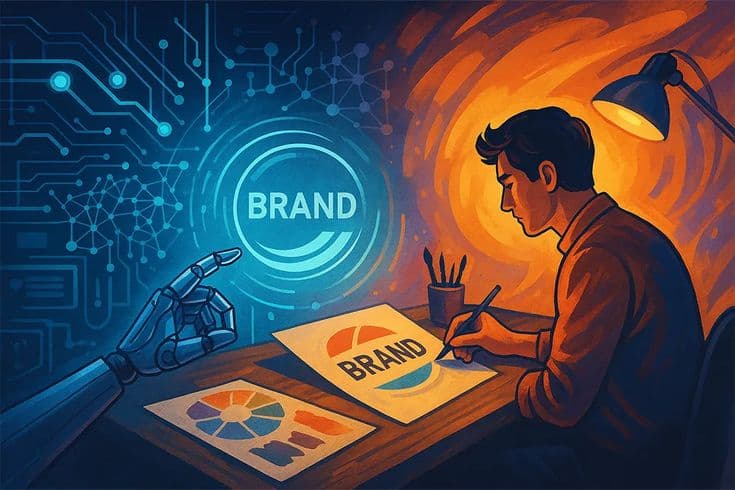


AI Can Write the Post. It Can't Be the Person Behind It.
A founder opens ChatGPT and types: “Write a LinkedIn post about leadership.” Ten seconds later, there it is. Clean opening. Three polished paragraphs. A neat lesson. A motivational ending. And absolutely nothing that sounds like the founder. That is the problem with using AI for personal branding. The technology is not necessarily making the content worse. It is making generic content incredibly easy to produce. And personal branding is supposed to do the opposite. A strong founder brand should make people feel like they understand how that person thinks. Their perspective, experiences, standards, opinions, and even the way they explain things should become recognisable over time. If AI removes all of that and replaces it with perfectly acceptable internet language, the founder may end up publishing more content while becoming less recognisable. The answer is not to stop using AI. It is to stop asking AI to be the founder. AI can help capture ideas, structure thoughts, research topics, repurpose conversations, challenge arguments, edit drafts, and turn one piece of thinking into several useful formats. But the thing worth building a personal brand around cannot be outsourced so easily. The founder's perspective has to come from the founder. AI should make that perspective easier to communicate, not manufacture a replacement for it.
Personal Branding Was Never About Producing More Content
This distinction matters before AI enters the conversation. A founder does not build a personal brand because the internet needs another person posting three times a week. They build one because their experience, expertise, or perspective can create value beyond the transactions happening inside their company. The founder might have spent fifteen years solving a particular problem. They might have made expensive mistakes competitors can learn from. They might understand an industry from the inside. They might have strong opinions about how their category operates. They might have a way of looking at customer behavior that most people have not considered. That is the raw material. The content is only the delivery mechanism. AI can make delivery faster. It cannot make a founder's experience more authentic simply by putting it into better sentences. This is why many AI-generated personal brands feel strangely empty. The posts contain information, but not much evidence that a particular human being has actually lived through what they are discussing. There is advice. There are frameworks. There are lessons. There are strong-sounding statements. But ask: Why should I believe this person specifically? That is where the content often falls apart.
The More AI You Use, the More Important Your Raw Thinking Becomes
There is an interesting contradiction here. AI makes content creation easier. That means generic content becomes cheaper and more abundant. Which means generic content becomes less valuable. If everyone can generate a polished post about leadership, entrepreneurship, productivity, or branding in seconds, simply having a polished post is no longer a differentiator. What becomes valuable is the thing AI does not automatically know. Your experience. The client conversation that stayed with you. The mistake you made three years ago. The decision you almost got wrong. The customer behavior that surprised you. The strategy you stopped using. The belief you changed your mind about. The industry practice you disagree with. The pattern you have noticed repeatedly. The lesson you learned the expensive way. This is where founders should start. Not with: “AI, give me five LinkedIn post ideas.” But with: “Here is something that happened. Here is what I thought at the time. Here is what I understand differently now.” Now AI has something worth working with. It is not inventing the insight. It is helping the founder shape the insight. That difference is enormous.
Give AI Your Thinking, Not Your Identity
One of the easiest ways to make AI-generated content sound generic is to give it a blank prompt. “Write a post about customer retention.” Of course the result sounds generic. AI has no idea what this founder actually believes about customer retention. Instead, the founder can provide raw material: “We lost a major client last year. At first I thought it was because of pricing. When we spoke to them, we realised the real problem was that our reporting had become too focused on metrics they didn't care about. We changed how we communicated results, and our next three client reviews were completely different.” Now there is something. The founder has supplied: Experience. Conflict. A wrong assumption. A realisation. A change. A lesson. AI can help turn that into a strong post. But the important idea already existed before AI touched it. That is the model founders should adopt: Founder provides the substance. AI helps with the structure. The more personal the subject, the more important this distinction becomes.
Do Not Ask AI to “Sound Like Me” Before You Know What “Like Me” Means
This is another common mistake. Founders tell AI: “Write this in my tone.” But what is their tone? Professional? Friendly? Confident? Conversational? Thoughtful? Those are not enough. Two founders can both be “professional and conversational” while sounding completely different. A recognisable voice comes from deeper things: What do you notice? What do you care about? What do you challenge? What do you refuse to compromise on? How do you explain complicated things? What kinds of examples do you naturally use? What phrases genuinely belong to you? What opinions have you formed through experience? What do you sound like when you are explaining something to a colleague rather than writing for an audience? That is voice. And AI cannot discover all of it from a generic instruction. The founder has to establish it first. Only then can AI become useful at preserving it.
Build a Voice Guide From the Founder, Not From a Prompt Library
Instead of repeatedly telling AI: “Make it authentic.” Build a real founder voice guide. It does not need to be complicated. It can contain actual examples of how the founder speaks and thinks. What I believe: Three to five principles the founder genuinely stands behind. What I disagree with: Industry assumptions, common practices, or advice they think is misleading. How I explain things: Whether they use stories, analogies, data, blunt statements, questions, or detailed examples. What I never say: Words, phrases, and corporate clichés that do not belong in their vocabulary. What I sound like: Actual transcripts, interviews, emails, speeches, videos, or previous posts. What I care about: The problems, people, or ideas they repeatedly return to. What I have experienced: Specific stories, decisions, failures, successes, and lessons. This gives AI something much more valuable than a style adjective. It gives it evidence. And evidence produces much better output than instructions like “make this sound human.”
The Founder Should Still Be the Source of the Opinion
This is perhaps the most important rule. If the post contains a strong opinion, the founder should be able to defend it. Not because AI cannot generate opinions. Because a personal brand is built around accountability for perspective. Suppose AI writes: “Businesses should stop chasing trends and focus on long-term brand building.” Fine. But ask the founder: Why? When did you learn this? What trend did you chase? What happened? When would you actually recommend using a trend? What would you tell a founder who disagrees? If the founder has no answer beyond the sentence AI generated, there is not much personal branding happening. There is just content production. A useful rule is: Never publish a strong personal opinion that you could not explain without AI. AI can sharpen the argument. It should not be the source of the belief.
Use AI to Turn One Founder Conversation Into a Content System
This is where AI becomes genuinely useful. Founders often have a content problem because they do not have an idea problem. They have a capture problem. They have brilliant conversations with clients. They explain things to employees. They answer questions in meetings. They make decisions. They tell stories. Then the useful thinking disappears because nobody captures it. Instead of asking a founder to sit down and “create content,” record a 30-minute conversation around a meaningful topic. Ask: What happened? What surprised you? What did you initially believe? What changed your mind? What would you do differently now? What do most people misunderstand about this? What would you tell someone facing the same problem? That conversation becomes raw material. AI can then help identify: One strong LinkedIn post. A short-form video script. A carousel concept. A longer article. Three follow-up questions. A founder POV. A customer education piece. A newsletter section. The founder does not have to manufacture seven ideas. The thinking already happened in one conversation. AI simply helps extract it. Do not use AI to manufacture more founder opinions. Use it to make sure fewer of the founder's existing opinions get lost.
Let AI Challenge the Founder, Not Just Agree With Them
There is another role AI can play that is often overlooked. Criticism. Founders do not need AI to constantly tell them their idea is brilliant. They need a tool that can push back. Give AI the draft and ask: What assumption am I making? What would a skeptical customer challenge? Where does this argument become too broad? What evidence is missing? What part sounds like generic LinkedIn advice? What would a competitor say against this? What is the strongest counterargument? Which sentence sounds like it could have been written by anyone in this industry? Now AI is acting less like a ghostwriter and more like an editor. That can make founder content significantly stronger. Because a founder's voice is not created by agreeing with everything they say. It becomes clearer when their ideas are tested.
Generic AI Language Is Usually a Symptom, Not the Problem
People often blame AI when a post sounds generic. But the deeper problem is usually that the input was generic. If you give AI: “Write about the importance of customer experience.” You will probably get generic content. If you give it: “Three months ago, one of our customers told me they did not actually care that our product had more features than our competitors. They cared that our onboarding took fifteen minutes instead of two hours. That conversation changed how we prioritise product improvements.” Now there is specificity. Specificity creates personality. The founder does not need to add slang or deliberately make the writing messy. The story itself makes the content feel human. This is why founders should not try to make AI content “less AI” by adding random casual phrases. Adding “Honestly,” “Here is the thing,” or “Let us be real” to every paragraph does not create authenticity. It creates another AI pattern. Specific experience beats manufactured personality.
Do Not Polish the Personality Out of the Draft
AI is extremely good at cleaning things up. That can also be dangerous. A founder might write: “I honestly didn't think this would work. We were basically throwing money at the problem because we didn't know what else to do.” AI turns it into: “Initially, we approached the challenge without a clear strategic framework, which led to inefficient resource allocation.” Technically cleaner. Emotionally dead. The first version sounds like a human admitting something. The second sounds like a consultant writing a report. Not every rough edge needs fixing. Sometimes the slightly unusual phrase, direct admission, or conversational sentence is exactly what makes the founder sound like themselves. Editing should improve clarity. It should not sterilise personality. A useful rule: Fix what makes the founder unclear. Keep what makes them recognisable.
Founders Do Not Need to Sound “Professional” All the Time
There is another reason founder content becomes generic. People assume authority requires corporate language. It does not. A founder can say: “I got this completely wrong.” “That sounded like a great idea. It wasn't.” “Here is what nobody told us when we started.” “We stopped doing this last year. Here is why.” “I don't agree with the advice everyone keeps giving founders about this.” Those sentences can create far more interest than: “In today's rapidly evolving business landscape…” The objective is not to make a founder sound less professional. It is to let them sound like a real professional with a point of view. There is a difference. Authority does not come from sounding like everyone else who has authority. It comes from having something worth saying and being willing to stand behind it.
AI Should Help Founders Sound More Like Themselves, Not More Like the Internet
This is the test worth applying to every AI-assisted post. Read it and ask: Could another founder in this industry publish this without changing anything? If yes, something is missing. Maybe the post needs a real story. Maybe it needs a stronger opinion. Maybe it needs a specific example. Maybe the founder's own experience needs to enter earlier. Maybe the argument is too broad. Maybe AI has polished away the interesting part. A second test: Would the founder actually say this out loud? If they would never say it in a meeting, interview, or conversation, why should their audience believe it belongs to them? A third: What part of this could only have come from this founder? That is the part worth protecting.
Use AI for the Parts That Drain Time, Not the Parts That Create Identity
There are plenty of tasks AI can make easier. Research organisation. Topic clustering. Transcription. First-draft structures. Repurposing. Headline variations. Content calendars. Editing. Summarisation. Content extraction from long conversations. Identifying recurring themes. Generating counterarguments. Turning long-form material into short-form formats. These are valuable because they reduce friction. But there are certain things founders should be extremely careful about outsourcing completely: Their core opinions. Their personal stories. Their values. Their experiences. Their decisions. Their expertise. Their disagreements. Their sense of humor. Their relationship with customers. Their worldview. Those are the things people are following the founder to hear. If AI does all of them, the founder may end up becoming the face attached to content they did not really create. That is not personal branding.
Do Not Make the Founder Approve 50 AI Posts. Give Them Better Inputs
There is also an operational problem. If a founder has to review fifty AI-generated posts every month, the system has not really solved the founder's workload. It has simply moved the workload to the approval stage. A better system begins upstream. Create a structured process for capturing founder thinking. A weekly 30-minute conversation. A running voice note. A document where the founder drops observations. Customer questions collected by the team. Interesting industry developments. Decisions made inside the company. Things the founder disagrees with. Stories that happened that week. AI can organise this material. A strategist can decide what is worth publishing. The founder can validate the thinking and add nuance. The content team can handle production. Now the founder is not becoming a content creator. They are becoming the source of the content system. That is a much more sustainable model.
The Founder Owns the Perspective. AI Helps Build the System.
This distinction also changes how an agency should work with founder-led brands. An agency should not simply ask a founder to approve a calendar full of generic posts. It should learn how the founder thinks. What do they know? What have they experienced? What do they believe? What would they never recommend? What questions do customers repeatedly ask them? What conversations make them passionate? Where do they disagree with the category? What stories prove their expertise? Once that material exists, AI can accelerate the process. But strategy still decides what matters. The founder still provides the perspective. The content team still decides how to communicate it. AI becomes part of the production infrastructure rather than the personality. That distinction is critical.
AI Can Help You Find the Founder POV Hiding Inside Ordinary Conversations
Sometimes the best founder content does not sound like content at all. It sounds like: “Why are clients still asking us this?” “I've noticed something interesting about our customers.” “We stopped doing this because…” “I don't understand why everyone in our industry…” “One thing we learned after working with…” “Here is what surprised me…” These are conversation starters. And they often contain more personal branding potential than carefully manufactured thought leadership. AI can help identify those moments. Give it a transcript from a founder interview and ask it to identify: Contrarian observations. Strong opinions. Unexpected lessons. Customer insights. Stories. Mistakes. Questions worth answering. Ideas that deserve deeper exploration. Then let the founder decide which ones actually matter. This is a much better use of AI than asking it to invent ten thought-leadership topics every Monday.
Your Personal Brand Should Still Be Able to Exist Without AI
This is the final test. If the AI tool disappeared tomorrow, could the founder still explain what they believe? Could they still tell their stories? Could they still answer customer questions? Could they still defend their opinions? Could they still speak for twenty minutes about their industry? If yes, AI is doing what it should. It is helping the founder communicate. If no, the brand has become dependent on the machine. And that creates a strange contradiction. The whole purpose of personal branding is to build a relationship around a person. Yet the content becomes increasingly detached from that person's actual thinking. That is precisely what founders should avoid.
What a Strong AI-Assisted Founder Content Workflow Actually Looks Like
There does not need to be a complicated system. The workflow can be surprisingly simple. First, capture the thinking. Record a conversation, write a rough note, answer a customer question, or document something that happened. Then, extract the insight. Use AI to identify the strongest arguments, stories, lessons, questions, and content opportunities. Then, choose the POV. The founder or strategist decides what is actually worth saying. Then, structure it. AI can help turn the raw thinking into a clear post, article, script, or carousel. Then, challenge it. Ask AI to identify generic statements, weak assumptions, missing context, and obvious counterarguments. Then, humanise through specificity. Add the real example, real experience, real opinion, or real language that makes the content belong to the founder. Finally, edit for voice. Not “make it sound human.” Make sure it sounds like this human. That last distinction is everything.
The Goal Isn't to Hide That AI Was Used
Founders sometimes worry that audiences will know AI helped write something. That should not be the main concern. The bigger question is whether the content contains something worth hearing. If AI helped organise a founder's thoughts, improve grammar, or turn a conversation into a polished post, that does not automatically make the content less authentic. Authenticity is not about proving that every word was typed manually. It is about whether the ideas, experiences, opinions, and meaning are genuinely connected to the person presenting them. A founder can use AI extensively and still sound unmistakably like themselves. Another founder can write every word manually and still sound completely generic. The tool is not the deciding factor. The distance between the content and the person's actual thinking is.
Do Not Use AI to Manufacture a Personal Brand. Use It to Scale a Real One.
AI has made one thing painfully obvious: Producing content is no longer the difficult part. Everyone can produce more. More posts. More captions. More scripts. More ideas. More carousels. More thought leadership. The competitive advantage increasingly shifts towards something else. Having something worth saying. A founder who has genuine expertise, strong opinions, real stories, and useful experience already has the most important ingredient. AI can help turn that into a repeatable content system. It can help the founder speak more consistently without requiring them to spend their entire week creating content. It can turn one conversation into multiple formats. It can challenge weak thinking. It can remove unnecessary friction. It can help a small team operate with greater creative leverage. But it should remain the infrastructure behind the voice, not the voice itself. Because people do not follow a founder to read what AI thinks a founder should say. They follow because they want to know: What does this person see that I don't? What have they learned that I can use? What do they believe strongly enough to defend? What can I understand differently because I listened to them? That is the part no prompt should replace.
Let AI Do More of the Work. Just Don't Let It Do the Thinking.
The smartest use of AI in personal branding is not to make founders sound more polished. It is to make their existing thinking more visible. Capture the conversation. Extract the insight. Challenge the argument. Build the structure. Repurpose the idea. Clean up the language. Then put the founder back into the content. Their experience. Their judgment. Their stories. Their opinions. Their way of seeing the world. That is what makes the content worth following. Because the future of founder-led content is not going to belong simply to the people who use the most AI. It will belong to the people who use AI without becoming indistinguishable from everyone else using it. Use AI to scale your voice. Don't use it to replace the reason people wanted to hear it in the first place.