

Is Your Social Media Trying to Sell Before Your Audience Is Ready to Buy?
Someone discovers your brand today. They don't know who you are. They don't know what makes you different. They haven't seen your product in action, read a review or decided whether they trust you. And your first interaction with them is: “Shop Now.” That isn't a content strategy. That's asking for a commitment before you've built a reason to make one. Social media audiences aren't standing in a queue waiting to purchase. Some people are discovering you for the first time. Some are curious. Some are researching. Some are comparing you with competitors. Some already want the product and are simply looking for reassurance before they act. Your content needs to meet each of them where they are. That's where awareness, consideration and conversion content become important. But there's a catch. These aren't three rigid boxes where every brand needs to publish three awareness posts, two consideration posts and one conversion post every week. Real customer journeys don't work that neatly. Someone can discover you through a product Reel and buy immediately. Someone else can follow you for six months before making a purchase. Another person might see a testimonial, leave your profile, encounter your brand again through UGC and only then become interested. So the real question isn't: “Which funnel stage does this post belong to?” It's: “What does this person need to see next?”
What Do Awareness, Consideration and Conversion Content Actually Mean?
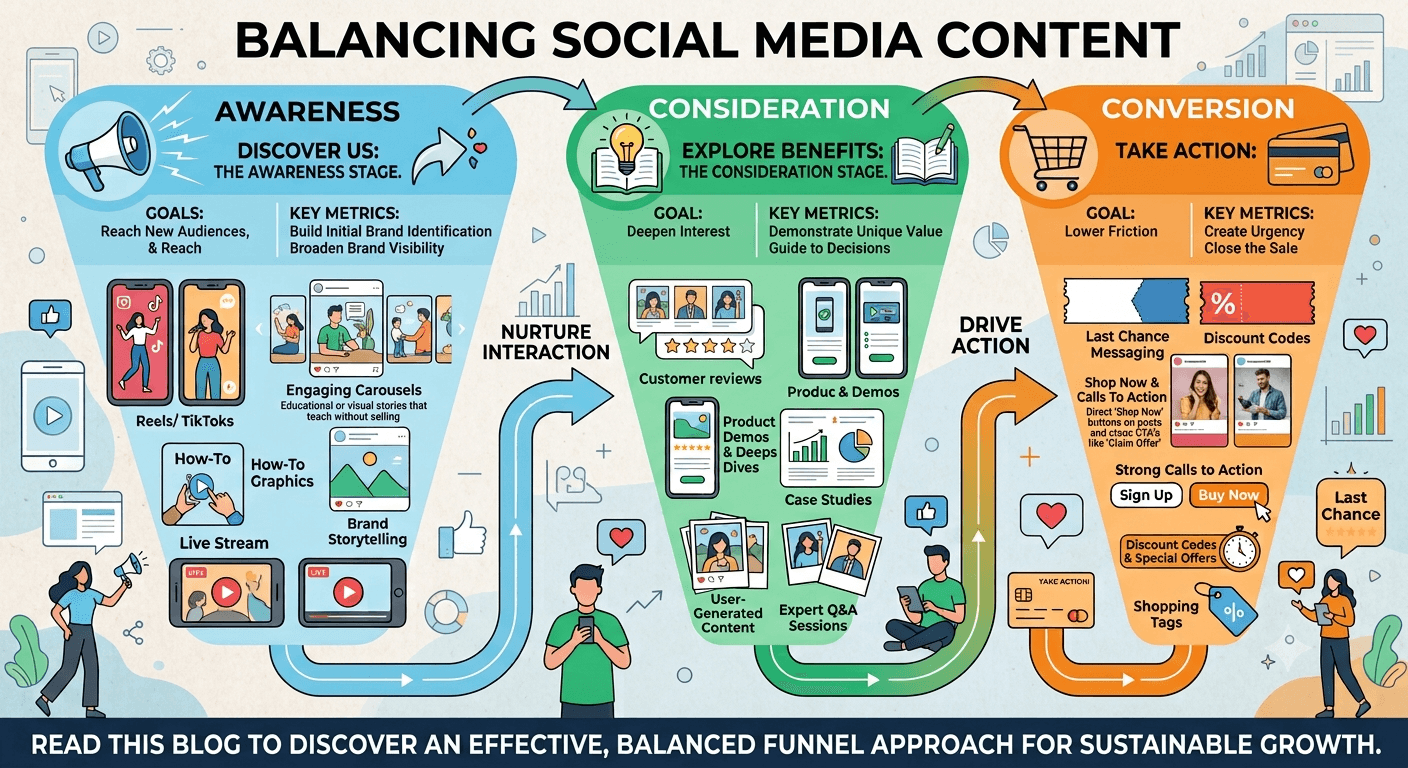
At the most basic level: Awareness gets you noticed. Consideration gives people reasons to care. Conversion gives interested people a reason to act. But those definitions become much more useful when you look at the customer's information needs. Take a fashion brand. An aspirational Reel introducing the brand's aesthetic to a new audience is awareness. A styling video showing three ways to wear the same outfit, a customer testimonial and a close-up of the craftsmanship move into consideration. A product-focused post showing availability, sizing, pricing and a clear purchase action supports conversion. The product hasn't changed. The audience's questions have. And that is the foundation of good social media strategy. Instead of repeatedly asking: “How many times should we show the product?” Ask: “What does someone need to understand before they're comfortable choosing it?” That question produces much better content.
Why Does Awareness Content Matter If It Doesn't Directly Sell?
Because people cannot consider a brand they don't know exists. Awareness is the beginning of the relationship. But awareness doesn't mean repeatedly shouting your brand name at strangers. It means giving someone a reason to stop. A reason to recognise something. A reason to become curious. A reason to think: “Wait, this is interesting.” Strong awareness content can introduce a brand, highlight a problem, communicate a point of view, establish a distinctive identity or connect with an audience around something relevant to them. And importantly, awareness content doesn't always need to feature the product. A skincare brand could discuss a common skincare mistake. A fashion brand could talk about wedding styling mistakes. An event management company could show an empty venue becoming a luxury celebration. The audience may not be ready to buy. That's fine. You're giving them a reason to care about the world your brand operates in.
Why Isn't High Reach the Same as Strong Brand Awareness?
Because people can remember the content without remembering the brand. Imagine your Reel receives 100,000 views. Fantastic. But ask yourself: How many of those people could identify your brand afterwards? If the answer is very few, you've created attention without necessarily creating meaningful brand awareness. That's the distinction brands need to understand. Good awareness content leaves an association behind. Perhaps people start thinking: “That's the skincare brand that makes ingredients easy to understand.” Or: “That's the fashion brand that has great wedding styling ideas.” Or: “That's the event company that shows what actually goes into producing luxury celebrations.” You're building mental real estate. And mental real estate becomes extremely valuable when the audience eventually needs what you sell.
What Is Consideration Content Actually Supposed to Do?
Once someone knows you exist, the next question becomes: “Why should I choose you?” That's consideration. This is where content needs to become more informative, specific and trust-building. Consideration content can include: Product demonstrations, UGC, Customer reviews, Testimonials, FAQs, Educational content, Comparisons, Expert explanations, Founder-led content, Behind-the-scenes stories, Product use cases, Detailed product storytelling. At this stage, the audience is evaluating you. They're asking: Does this work? Is this right for me? How is it different? Can I trust this company? Is it worth the price? What are other customers saying? Your content should begin answering those questions before the customer has to ask them.
Why Is UGC So Powerful During Consideration?
There's a major difference between a brand saying: “Our product delivers incredible results,” and a real person showing how they use it and explaining their experience. The second provides context. That's why UGC can be particularly powerful during consideration. It can show people what the product looks like in real life, how it fits into someone's routine, what problem it solves and whether they can imagine themselves using it. But here's an important distinction: UGC isn't automatically consideration content. The strategy determines its role. A creator introducing a product to an audience can support awareness. A creator demonstrating how the product works can support consideration. A creator answering objections, showing proof and giving people a reason to act can support conversion. Same format. Different objective. That's why social media strategy cannot be reduced to saying, “We need more Reels” or “We need UGC.” The format is only the vehicle. The message determines where it takes the audience.
What Should Conversion Content Actually Do?
Now consider someone who already knows your brand, understands the product and is seriously considering buying. This is where conversion content enters. And this is also where many brands suddenly become aggressive. BUY NOW. SHOP NOW. LIMITED TIME. DON'T MISS OUT. Every other post starts sounding like a salesperson chasing someone down the street. It doesn't have to. Conversion content has a much more useful job: Make the value of taking action clearer than the hesitation of doing nothing. That might involve showing the product's strongest benefit, demonstrating how it works, presenting customer proof, removing a common objection, clarifying availability or simply making the next step obvious. The CTA matters. But a CTA isn't a magic button. “Shop Now” cannot rescue content that hasn't created enough trust or desire to make someone want to shop. The content has to earn the action.
What Happens When Every Post Is Trying to Convert?
Your audience learns to tune you out. It's not necessarily because your product is bad. It's because you've turned your entire social presence into a catalogue. Imagine meeting someone at a party. You introduce yourself. They immediately ask you to buy something. You decline. They explain the product. You still decline. They ask again. Eventually, you're looking for an excuse to leave. That's what happens when brands treat every Instagram post as a sales pitch. Social media isn't a catalogue with better lighting. It's a relationship-building environment. Some content should make people discover you. Some should make them understand you. Some should make them trust you. Some should make them remember you. And yes, some should make them buy. Give every piece of content a job.
Does Every Post Need to Have Only One Funnel Stage?
No. A single piece of content can do multiple things. A founder-led Reel could introduce a brand while establishing authority. A UGC video could attract new audiences, demonstrate the product and encourage consideration. A testimonial could build trust while also supporting conversion. The important thing is knowing the primary objective. Otherwise, content starts trying to communicate everything at once. And when one post tries to educate, entertain, sell, introduce the founder, explain the product and answer every possible objection, it often ends up communicating nothing clearly. Strategic content knows what matters most.
Why Do Brands Struggle When They Skip Consideration?
This is one of the most common social media mistakes. A brand spends months creating awareness content. Views increase. Followers increase. People discover the account. And then the founder asks: “Why aren't these people buying?” Because awareness and purchase intent aren't the same thing. You've told them: “We exist.” You haven't necessarily told them: “Here's why you should choose us.” That's consideration. Imagine a premium skincare brand. A potential customer sees beautiful Reel after beautiful Reel. The branding looks excellent. The photography is polished. The page feels premium. But they still don't know: What does the product actually do? Who is it for? How should they use it? What makes it different? Does it work? What do customers think? Is it worth the price? Beautiful content earned the attention. Consideration content gives that attention somewhere to go.
Can You Have Too Much Consideration Content?
Yes. The opposite problem is possible too. A brand can spend months explaining its products, publishing testimonials and demonstrating features without creating enough new discovery. The existing audience gets more information. But the audience itself doesn't expand. That's why awareness and consideration need to work together. You need people entering the ecosystem. Then you need reasons for those people to go deeper. And eventually, you need content that makes action easier.
Why Isn't the Customer Journey Always Awareness → Consideration → Conversion?
Because real people are chaotic. Marketing funnels are useful frameworks. Real customers are not funnels. Someone can discover your brand through a product demonstration and purchase five minutes later. Someone else might discover you today, follow you, forget about you, return through an ad three months later, watch a testimonial and finally buy. Someone may already trust the category and only need pricing. Another person may need five different pieces of proof before feeling comfortable. So don't become obsessed with forcing every person through the exact same sequence. Instead, think about your content as an ecosystem. Different pieces should answer different psychological and informational needs. Your responsibility is to make sure those needs are covered.
How Can Awareness Content Create More Than Just Views?
Let's make this practical. Suppose you're a premium fashion brand. A weak awareness post might say: “Our new collection is here. Shop now.” It tells people what you're selling. It doesn't give strangers much reason to care. A stronger awareness idea could be: “The wedding guest outfit mistake that can make even an expensive outfit look ordinary.” Now you've created curiosity. You've identified a problem your target audience understands. You've given them a reason to stop. And your product can enter that conversation naturally. That's strategic awareness. You're not simply announcing the brand. You're making the brand relevant.
What Does Strong Consideration Content Look Like?
Now imagine that same person has seen several pieces of your content. They're interested. This is the moment to help them evaluate. Show them: How the outfit looks on different body types, Different styling options, Fabric and craftsmanship details, Real customers wearing it, Customer experiences, the thinking behind the design, what makes the piece different, how the brand approaches styling. Now you're answering: “Why this?” You're reducing uncertainty. And reducing uncertainty is one of the most important jobs of consideration content.
What Should Conversion Content Look Like?
Now imagine someone has explored your profile, watched your content, considered the collection and is close to purchasing. They don't necessarily need another inspirational Reel. They need clarity. Show the product clearly. Explain the important details. Address the final objection. Include relevant pricing or availability information. Provide social proof. Make the purchase process straightforward. Give them a clear CTA. Now you're answering: “Why should I act?” That's conversion. The difference is subtle but important: Awareness creates interest. Consideration reduces uncertainty. Conversion reduces friction.
Should Reels Always Be Awareness Content?
No. This is another common misconception. A Reel can do almost anything depending on its message. A Reel introducing a brand to strangers can create awareness. A Reel demonstrating a product can support consideration. A Reel showing customer results and addressing an objection can support conversion. The same applies to carousels, UGC, testimonials, influencer content, founder videos and product photography. Don't build your strategy around: “Reels = awareness.” Build it around: “What is this content supposed to accomplish?” That's a much stronger framework.
What Should You Measure at Each Stage?
This is where brands need to stop treating every number as equally important. For awareness, look at: Reach, views, discovery and audience growth. But don't stop there. Ask whether the people discovering you are actually relevant. For consideration, look at: Saves, shares, meaningful engagement, profile visits, repeat viewing and product interest. These signals suggest that people are doing more than passively consuming the content. For conversion, look at: Clicks, inquiries, leads, product actions, bookings, purchases or whatever business outcome the campaign is designed to generate. The exact metrics depend on the business. There is no universally superior social media metric. The objective determines the metric.
What If an Awareness Reel Gets 500,000 Views but Produces No Sales?
Don't immediately call it a failure. Ask what the Reel was designed to achieve. If it was awareness content, discovery may have been the objective. If it was educational content, saves and shares may be more meaningful. If it was consideration content, profile visits and product interest may matter more. If it was explicitly designed to generate purchases and produced massive reach but almost no commercial action, then yes—the strategy needs to be examined. Performance only makes sense in context. A viral post isn't automatically successful. A low-view post isn't automatically useless. The objective tells you how to interpret the result.
What Happens If Your Content Has No Clear Next Step?
Here's a question every social media team should be asking: “If someone engages with this post, what do we want them to see next?” That single question can dramatically improve content strategy. Someone discovers the brand through an awareness Reel. The next piece could establish expertise. Someone watches a product demonstration. The next piece could show a testimonial. Someone watches a testimonial. The next piece could demonstrate the product in real life. Someone is showing strong purchase intent. The next piece could remove the final objection. That's more than content creation. That's content sequencing. And sequencing is one of the clearest differences between simply posting and actually marketing.
Why Does Random Posting Make Social Media Feel Disconnected?
Random posting can produce random wins. One Reel gets 200,000 views. The next gets 2,000. A carousel gets shared. The next disappears. A product post generates an inquiry. Then two weeks of unrelated content follow. The problem isn't necessarily creativity. It's the lack of a system connecting the content. A strong social media presence should feel like the pieces belong to one brand and collectively move the audience toward a clearer understanding of the business. Not like someone opened Canva every Tuesday and asked: “Okay, what should we post today?”
How Does SocialUp Marketing Approach Awareness, Consideration and Conversion?
This is where social media marketing becomes more than content production. At SocialUp Marketing, the starting question isn't: “What should we post this week?” It's: “What is the brand trying to achieve, and what does its audience need to see?” That begins with understanding the brand. Its positioning. Its audience. Its product or service. Its identity. Its objectives. Its existing content. Its competitive environment. From there, the content strategy can determine which messages need to create discovery, which need to build trust and which need to encourage action. A fashion brand doesn't necessarily need the same awareness strategy as a fintech brand. A skincare brand doesn't need the same consideration strategy as an event management company. A founder building authority doesn't need the same conversion journey as a D2C product brand. The framework can be shared. The strategy shouldn't be identical.
Why Does Content Sequencing Matter More Than Simply Increasing Content Volume?
Because more content doesn't automatically mean more progress. If someone sees ten awareness posts but never encounters proof, education or product context, you're creating attention without depth. If someone sees ten conversion posts but has never encountered meaningful brand storytelling, you're asking for action without enough trust. If someone sees ten educational posts but never gets a clear reason to act, you're creating knowledge without movement. The strength comes from the relationship between the pieces. One post opens the door. Another explains. Another proves. Another reassures. Another creates urgency. Another makes action easy. That's a content ecosystem. And that's much more powerful than simply increasing the number of posts on the calendar.
So, How Should You Actually Balance Your Content?
Don't begin by asking: “How many awareness posts should we publish?” Begin with: “What does our audience need right now?” Then map the content around those needs. Awareness: Help people discover you. Create curiosity. Introduce problems, perspectives, stories and ideas that are relevant to your brand. Consideration: Help people understand you. Demonstrate. Educate. Show proof. Answer questions. Build credibility. Conversion: Help interested people act. Clarify value. Remove hesitation. Provide evidence. Make the next step obvious. But don't turn these into three isolated content calendars. They are strategic purposes that need to work together.
What Does Your Audience Need to Believe Before They Buy?
This is the question that can transform a content strategy. Maybe they need to believe your product works. Maybe they need to believe it is worth the price. Maybe they need to believe your company understands their problem. Maybe they need to believe other people like them have had a good experience. Maybe they need to believe the purchase process will be easy. Maybe they simply need to know you exist. Different beliefs require different content. And that's why context changes everything. Someone considering a ₹500 purchase may need very different reassurance from someone considering a ₹50,000 service. Someone buying skincare needs different proof from someone booking a luxury wedding planner. Someone discovering a brand for the first time needs different information from someone who has been following it for six months. The audience's position changes what your content needs to accomplish.
Don't Ask Every Post to Sell. Give Every Post a Job.
The strongest social media accounts aren't necessarily the ones producing the most content. They're the ones where the content feels intentional. One post introduces. Another intrigues. Another educates. Another demonstrates. Another proves. Another builds trust. Another creates desire. Another converts. Sometimes one piece can do several of these things. But there is always a reason it exists. That's the difference between: “We need five posts this week.” and: “What does our audience need to understand, feel or believe next?” At SocialUp Marketing, that second question is where strategy begins. Because content shouldn't exist simply to fill your Instagram grid. It should move the audience—even when the next step isn't a purchase. Awareness gets you noticed. Consideration gives people reasons to choose you. Conversion gives interested people a reason to act. But strategy? Strategy knows which one your audience needs from you right now.